Stop Managing Personalities. Start Understanding Patterns.
Beyond Personality Clashes: Managing the 3 Rhythms of Team Tension Under Pressure.
Have you ever walked out of a meeting wondering how people can sit in the same room, discuss the same issue, and respond as though they are having completely different conversations?
One person wants to move immediately into action.
Another wants to make sure everyone has been heard, the right process is followed, and the team does not make a careless decision.
Someone else goes quiet—not because they are disengaged, but because they need space to think, feel, or make sense of what is happening before they can contribute meaningfully.
Same room. Same pressure. Completely different movements.
This is one of the reasons team dynamics can become so complicated. We often assume that other people should respond to pressure the way we do. When they do not, we start creating stories:
“They are being controlling.”
“They are overthinking this.”
“They do not care.”
“They are making this too emotional.”
“They are avoiding the issue.”
“They are slowing us down.”
“They are not taking this seriously enough.”
But very often, what we are judging is not someone’s character. We are simply seeing a different pattern of response.
This is where the Enneagram becomes so useful. Not as a way to label people, put your colleagues into boxes, or create a shortcut for explaining away behaviour. At its best, the Enneagram gives us a more compassionate and accurate map of human behaviour. It helps us understand not only what people do, but why they are doing it.
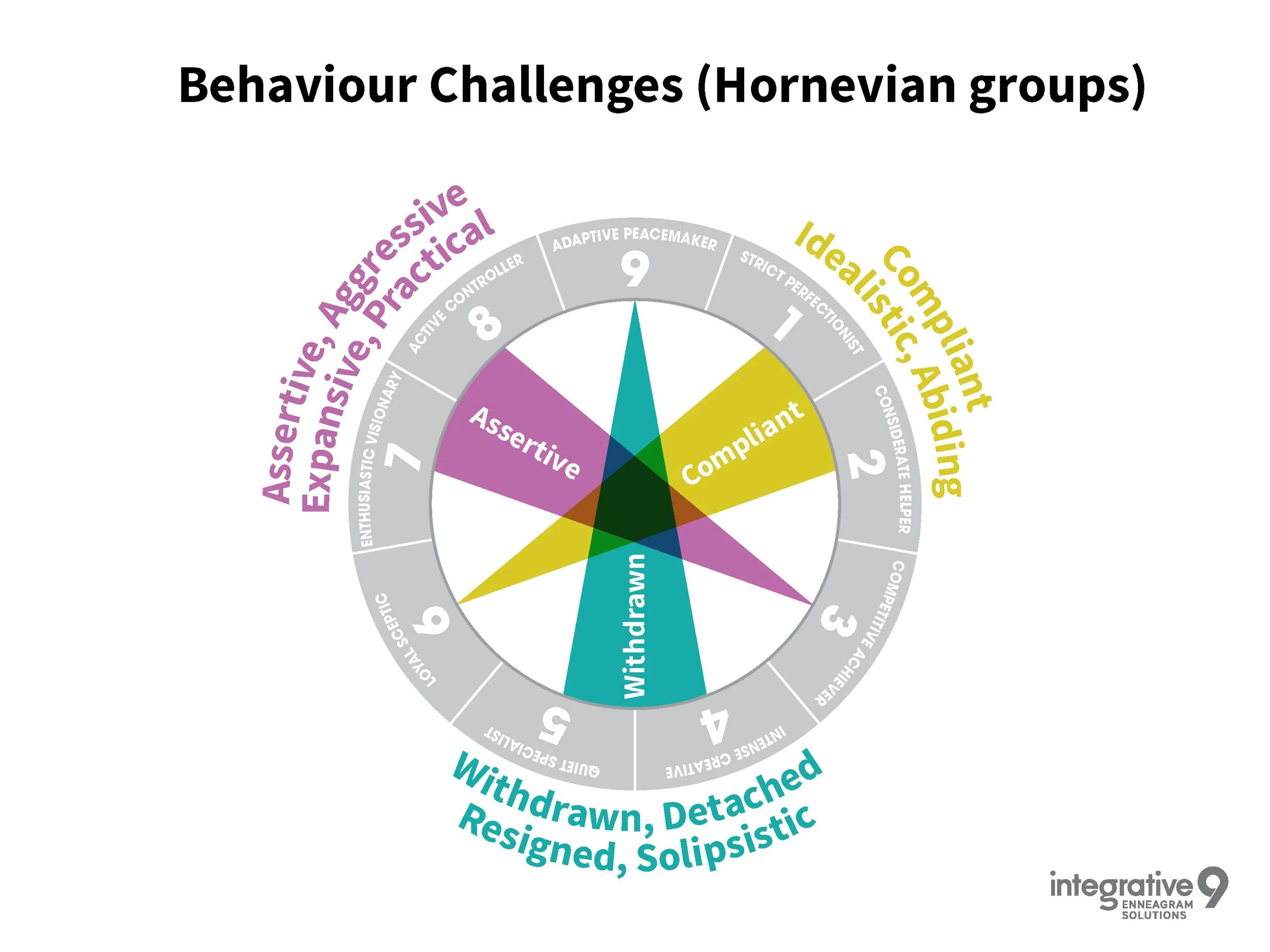
One of the most practical lenses for leadership and teams is known as the Hornevian groups, originally derived from the groundbreaking work of psychoanalyst Karen Horney and mapped to the Enneagram by modern teachers like Russ Hudson and Don Richard Riso.
That may sound technical, but the concept is beautifully simple: When pressure hits, people instinctively move in different directions to find clarity and safety.
Some people move into action. Some people move towards duty and responsibility. Some people move away to process.
Understanding these three distinct movements can fundamentally change the way we lead, communicate, and collaborate. Because once you can see the movement, you stop misreading the person.
Moving Into Action (The Assertive Types: 3, 7, and 8)
There are people who respond to pressure by moving forward. They want momentum, options, a plan, and immediate execution. They are the initiators. In Enneagram language, these are the Assertive types: Types 3, 7, and 8.
This group includes the Competitive Achiever (3), the Enthusiastic Visionary (7), and the Active Controller (8). These are the individuals who naturally think:
“Let’s solve this.”
“What is the next step?”
“How do we keep moving?”
“Who is taking ownership?”
At their best, they bring energy, confidence, and direction. They cut through hesitation and get things moving when a team feels stuck. In a crisis, this courage and drive helps a team avoid analysis paralysis. Their inner logic is: “If we keep moving, we will be okay.”
The Pressure Trap:
Under pressure, this strength can be overdone. They may move too quickly, override others without realising it, and become impatient with deep reflection, emotion, or uncertainty.
To someone who needs more time, they can seem reckless or forceful. But they aren't trying to dominate the room; they are trying to manage their own discomfort by generating momentum.
The Leadership Invitation:
The goal is not to shut this energy down, but to channel it well. A leader might say:
“Your ability to move us forward is valuable. Let’s make sure we also slow down enough to hear what the rest of the team is seeing first.”
2. Moving Towards Responsibility (The Dutiful Types: 1, 2, and 6).
There are people who respond to pressure by turning towards what is expected, needed, or right. They are constantly scanning for responsibility, alignment, and structure. In Enneagram language, these are the Compliant or Dutiful types: Types 1, 2, and 6.
This group consists of the Strict Perfectionist (1), the Considerate Helper (2), and the Loyal Sceptic (6). The word "compliant" is often misunderstood here—it does not mean weak or passive. It means a movement toward duty, principle, systems, and service. And more often than not, it is compliance to the super ego.
These individuals think:
“What is the right thing to do here?”
“Who needs support?”
“What could go wrong if we miss a step?”
“How do we ensure this is fair and properly handled?”
At their best, they bring immense integrity, care, commitment, and reliability. They notice the risks others miss, consider the impact on the group, and hold the standard when everyone else is rushing ahead. Without them, teams become careless and reactive. Their inner logic is: “If I stay responsible, we will be okay.”
The Pressure Trap:
Under intense pressure, this weight becomes heavy. They may over-function, struggle to trust that others care as much as they do, and become anxious or resentful if they feel they are the only ones holding the line.
They can easily become frustrated with the Assertive types (who look irresponsible to them) or the Withdrawn types (who look unavailable).
The Leadership Invitation:
The invitation is to honour their care without letting them carry the entire burden alone. A leader might say:
“I see how much responsibility you are holding here. Let’s separate what is yours to own from what belongs to the broader team.”
3. Moving Away to Regain Clarity (The Withdrawn Types: 4, 5, and 9)
There are people who respond to pressure by stepping back. Sometimes this is physical—they need a moment before answering or prefer to reflect before committing. Sometimes it is internal—they are present, but processing, listening, sorting, and observing beneath the surface. In Enneagram language, these are the Withdrawn types: Types 4, 5, and 9.
This group includes the Intense Creative (4), the Quiet Specialist (5), and the Adaptive Peacemaker (9).
Russ Hudson refers to this group as 'The Strategic Long View'. This movement is the most frequently misread in corporate settings. Silence is mistaken for indifference, reflection is mistaken for hesitation, and a quieter presence is mistaken for a lack of opinion. Yet, their internal world is highly active, thinking:
“I need a moment to understand what I actually think.”
“There is more going on here than we are naming.”
“I do not want to respond before I have objective clarity.”
At their best, they bring depth, perspective, calm, and profound insight. They see what the room is missing and prevent reactive, surface-level decisions. Their inner logic is: “If I create space, I will be okay.”
The Pressure Trap:
Under pressure, reflection can turn into total withdrawal. They may retreat into their thoughts, withhold critical perspectives until it is too late, or hope the tension passes instead of stepping into it.
This causes immense frustration for Assertive types (“Why aren’t you contributing?”) and Dutiful types (“Why am I the only one taking this seriously?”).
The Leadership Invitation:
The invitation is to give them space without allowing them to disappear. A leader might say:
“I know you need time to process this. I highly value your perspective, so I’m going to come back to you in a few minutes before we finalise our decision.”
The Real Problem is Misinterpretation.
Most team tension does not come from the fact that we are different. It comes from the stories we attach to those differences.
The person who moves quickly assumes the quieter person is disengaged.
The person who needs time assumes the fast-moving person is reckless.
The person who feels responsible assumes others do not care enough.
The person who steps back feels the room is simply too loud to enter.
Suddenly, the team is no longer solving the actual business problem. They are navigating a web of emotional assumptions.
Self-awareness is not a soft skill; it is a strategic leadership capacity. The less aware I am of my own default movement, the more likely I am to judge yours. If I believe my way of handling pressure is the only correct way, I will turn every operational difference into a character flaw.
What This Means for Leaders.
Healthy teams require all three rhythms.
A team of purely Assertive types will move incredibly fast but break things, missing critical nuance.
A team of purely Dutiful types will care deeply but risk becoming bogged down, heavy, and risk-averse.
A team of purely Withdrawn types will possess immense depth but struggle to generate execution momentum.
High-performing teams don't choose one rhythm over another; they learn how to make room for all three. Sometimes the team needs your pace. Sometimes it needs your care. Sometimes it needs your pause.
The next time pressure rises in a meeting, stop asking, “Why are they being difficult?”
Instead, look at the dynamics and ask: “What movement am I seeing right now, and how do we work with it consciously?”
When you change the way you look at team patterns, you change the entire culture of your organisation.
Here's to seeing our patterns,
Warm wishes,
Lori