Why We All Procrastinate — But for Very Different Reasons.
I was thinking recently about how often we talk about time as though it is the enemy.
There is never enough of it. We are always running out of it. We promise ourselves we will “manage it better” next week, next month, or next quarter.
And yet, two people can have the exact same 24 hours and behave completely differently within them.
One delays because they are afraid it won't be "perfect." Another delays because they are overwhelmed by everyone else’s needs. Another won't start because they can’t guarantee success. Another keeps busy with "pleasant" things to avoid sitting with discomfort.
Same behavior. Different motivation. Different avoidance.
That is why I find the Enneagram so powerful. It shows us that our attention is not random; it is patterned. And more importantly: Our attention often goes exactly where our avoidance lives.
Read that again.
We tend to think attention is about what matters most to us. But often, our attention is pulled toward the very thing we are trying not to feel.
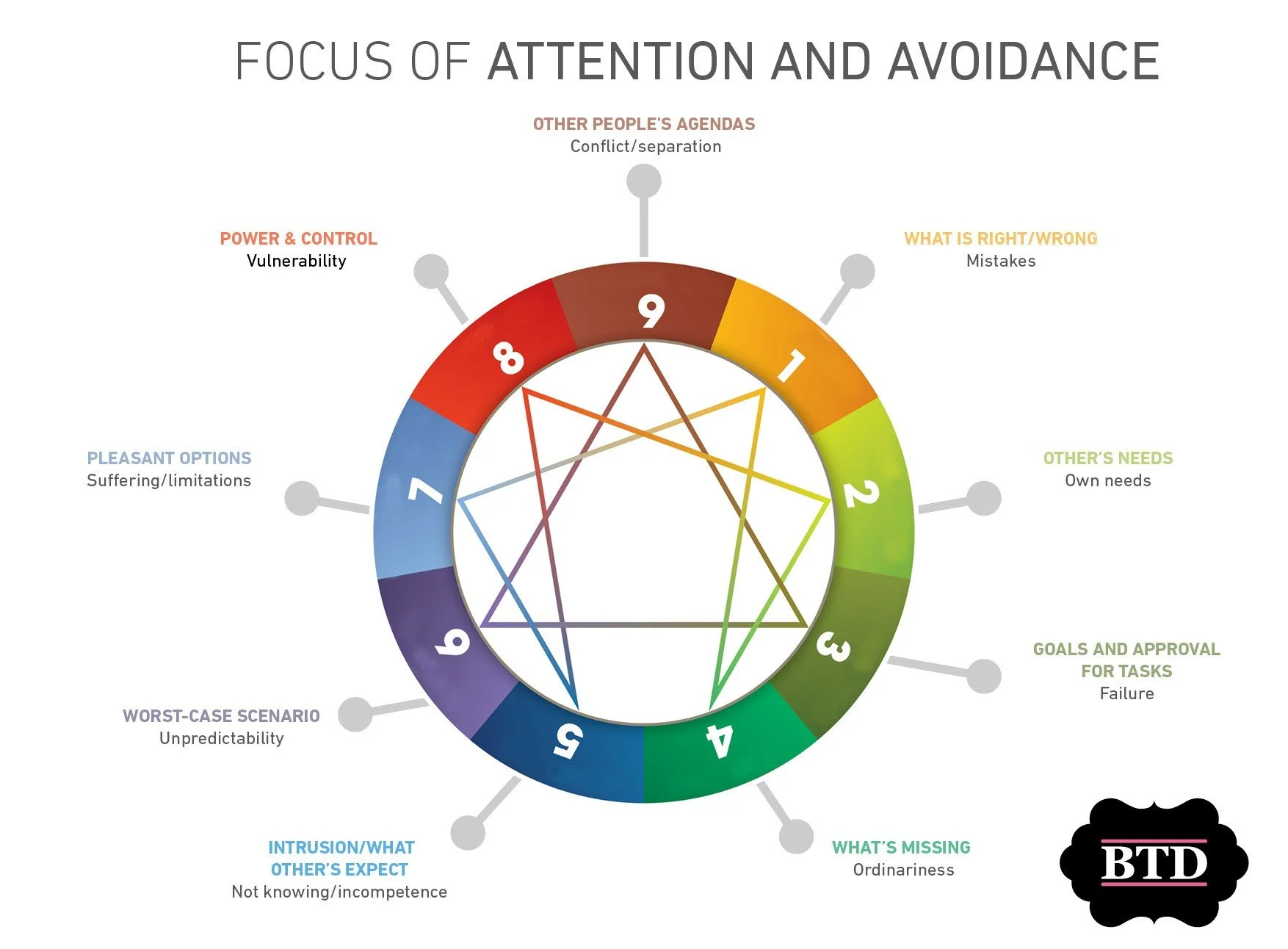
Each Enneagram type has a habitual focus—but underneath that focus is something they are trying to avoid. What looks like hesitation, people-pleasing, or overthinking on the outside is driven by a very specific internal engine.
Because procrastination is not laziness. It is a window into what we are trying hard not to experience:
Type One may delay because if they cannot do it "right," they would rather not risk a mistake.
Type Two may stall on their own priorities because everyone else’s needs feel more "urgent" than their own.
Type Three may procrastinate on a meaningful project because the possibility of not being the best feels too exposing.
Type Four may wait for the "right mood," caught between the desire for meaning and the fear of being ordinary.
Type Five may put something off because they don’t yet feel informed or "ready" enough to execute.
Type Six may hesitate because they are trying to solve every "what if" scenario before taking the first step.
Type Seven may redirect their energy to more exciting options to escape the "trap" of a tedious or restrictive task.
Type Eight may delay a task that makes them feel vulnerable or out of control.
Type Nine may put off their own "big" goals to maintain a sense of internal peace, choosing familiar routines over the discomfort of a potential conflict or change.
So yes, we all procrastinate. But why we do it matters. If you only deal with the behaviour, you miss the deeper pattern.
I don’t believe most people have a "time" problem. I believe many of us have an attention problem. And beneath that, an avoidance problem.
We say, “I need to manage my time better.” But perhaps the better question is: What is my attention organising itself around?
Because your attention is always telling the truth.
If you are scanning for mistakes, your time goes into refining. If you are scanning for approval, your time goes into performing. If you are scanning for discomfort, your time goes into escaping or avoidance.
Real time management is actually self-management. And self-management begins with self-observation.
Not judgment. Not fixing. Observation.
The Enneagram is a map of motivation. It helps us see that our days are not only shaped by our goals; they are shaped by our habits and our automatic ways of protecting ourselves.
Until we see that, we keep misdiagnosing the issue. We buy another planner. We create another to-do list. We tell ourselves to "try harder."
But the real work is often quieter and deeper: To notice where your attention is circling. To understand that avoidance has a cost. And to gently choose differently.
Freedom is found in seeing your pattern clearly enough that you no longer have to be run by it.
So the next time you procrastinate, instead of asking, “What is wrong with me?” try asking:
“What am I avoiding right now?”
“What is my attention locked onto?”
“What is this behaviour trying to protect me from?”
Those questions will open up far more change than any productivity hack ever will. It is not only about how we spend our time—it is about what has captured our attention.
And that is where real change begins.
Here’s to self-observation,
Warm wishes,
Lori