Why You Clash With Certain People at Work.
Ever walked out of a meeting thinking, How are we even having the same conversation?
You are discussing the same issue. Using the same words. Sitting in the same room.
And yet somehow, everyone seems to be responding to a completely different reality.
This is one of the reasons I find the Enneagram so useful in teams. Not because it puts people in boxes, but because it helps us understand the pattern beneath the behaviour.
And for leaders, that matters.
Because so much of what slows teams down is not bad intent. It is not incompetence. It is not even the issue itself.
It is the invisible pattern each person reaches for when things become uncomfortable.
One of the most practical ways the Enneagram helps us see this is through something called the harmonics.
The harmonics describe how we tend to communicate when there is disappointment, tension, frustration or conflict.
In other words:
What do you sound like when life is not going your way? And what do you most need from others in that moment?
This matters enormously in teams.
Because what feels honest and helpful to one person can feel dismissive, aggressive or exhausting to another.
The three harmonic groups offer a simple way to understand why people respond so differently when tension arises.
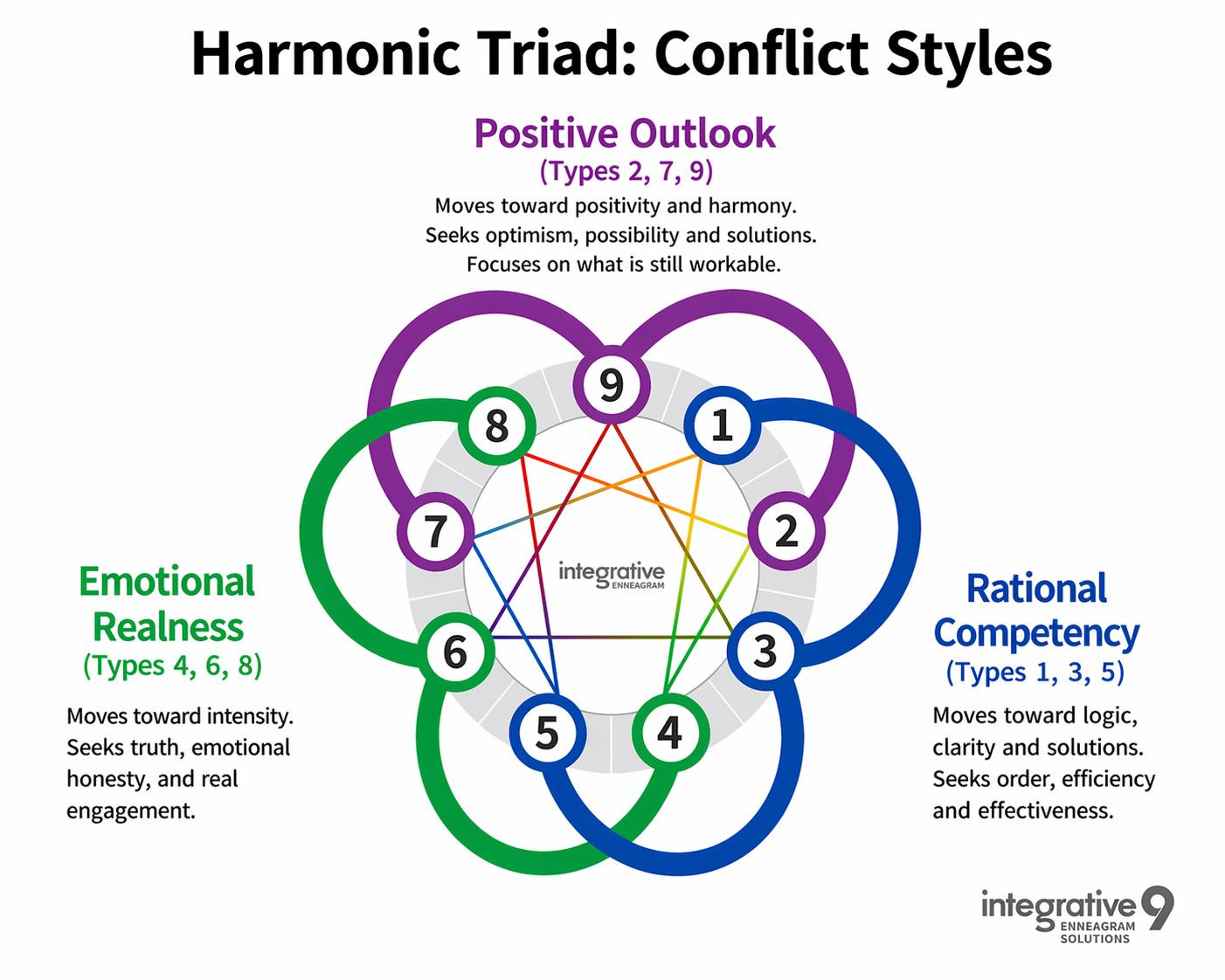
These are not rigid boxes. They are simply useful lenses. Once we understand the pattern beneath the behaviour, we are often able to meet one another with more wisdom and far less judgment.
1. The Positive Outlook group (Types 2, 7 and 9)
When tension rises, these types tend to move away from discomfort and toward what feels uplifting, workable or manageable.
They often want to keep the atmosphere upbeat. They may reframe, soften, minimise, move on, or focus on what is still possible.
At their best, they bring hope, resilience and perspective.
But under pressure, others may experience them as:
avoiding the real issue
glossing over what hurts
staying positive at the expense of honesty
And this is often where team frustration begins.
Because while one person is trying to reduce the pain in the room, someone else is thinking:
Why are we not talking about the actual problem?
2. The Emotional Realness group (Types 4, 6 and 8)
When something is wrong, these types tend to move toward the intensity.
They want the truth on the table. They want to know where people really stand. They often trust what is direct, unfiltered and emotionally real, so when they don't sense that from others, it can create mistrust.
And usually, when they are upset, you can see it before they say a word. It shows up in their body language, facial expressions, and tone.
At their best, they bring courage, honesty and a willingness to address what others avoid.
But under pressure, others may experience them as:
too intense
confrontational
provocative
escalating the room
Meanwhile, from their side, they are often thinking:
Can we stop pretending and just be real?
3. The Rational Competency group (Types 1, 3 and 5)
When difficulties arise, these types tend to cope by becoming more objective, composed and task-focused.
They want to solve the issue. They may detach from emotion to restore order, effectiveness, or clarity.
At their best, they bring structure, capability and calm problem-solving.
But under pressure, others may experience them as:
cold
overly controlled
impatient with feelings
more loyal to the task than to the relationship
And from their side, they may be thinking:
Can we be effective here instead of getting lost in emotion?
Now imagine these three styles in the same meeting.
One person is trying to keep things light. One person is pushing for honesty. One person is trying to solve the problem efficiently.
And all three leave feeling misunderstood.
The Positive Outlook person feels: Why is this becoming such a drama?
The Emotional Realness person feels: Why is nobody saying what is really going on?
The Rational Competency person feels: Why can’t we just deal with this properly?
This is the moment where teams start making dangerous assumptions.
We stop seeing coping style. And we start making character judgments.
We tell ourselves:
they are avoidant
they are difficult
they are insensitive
they are too much
they are emotionally immature
they are impossible to please
But often, what we are actually seeing is something much more human:
A person trying to restore safety in the only way they know how.
Every pattern holds a certain wisdom, even if it does not always serve the moment.
And once we understand the pattern, we can work with it more consciously.
A healthy team does not need everyone to communicate the same way.
It needs people to recognise:
what they do under stress
how that impacts others
what kind of response they tend to overuse
and what flexibility leadership now requires
Because maturity is not just knowing your style.
It is noticing when your style is no longer serving the conversation.
What this means for leaders.
This is where the Enneagram becomes more than interesting.
It becomes deeply practical.
Because when you can recognise the different ways people respond to tension, you can lead the conversation with far more skill.
You can say to the Positive Outlook style: “I know this feels challenging, but you are not alone in it — we will work through it together.”
You can say to the Emotional Realness style: “Your honesty matters here. Let’s make space for it in a way others can hear.”
You can say to the Rational Competency style: “Your clarity is valuable. And before we solve this, let’s make sure we understand what is happening for people.”
That is leadership.
Not forcing everyone into one preferred communication style.
But widening your own range so that more people can stay engaged, honest and responsive under pressure.
The harmonics are not about expecting people to meet you where you are, but about learning to meet others where they are.
Real resolution happens when we stop expecting everyone to use our language.
If you are a Rational Competency person (1, 3, 5) dealing with an Emotional Realness person (4, 6, 8), simply saying let’s be logical may sound, to them, like you are dismissing their reality.
Conversely, telling a Positive Outlook person (2, 7, 9) to just be realistic may cause them to shut down altogether.
To lead a high-performing team, you do not need to change your style.
But you do need to learn the other two languages.
Because when you make contact with others in a way that respects how they process tension, the atmosphere begins to shift.
Defensiveness softens. People feel met. And conflict becomes far more likely to turn into collaboration.
This is not about typing colleagues from across the boardroom.
It is about noticing patterns — including your own — with more humility and less judgment.
That is why I use the Enneagram in leadership and teamwork.
Not as a label. Not as the whole answer. But as a practical lens that helps people understand why communication breaks down so quickly — and what more conscious communication can look like instead.
Because most team conflict is not just about the issue on the table.
It is about the pattern each person brings to the table when the issue becomes uncomfortable.
And once you can see that, you can lead differently.
The leaders who build strong teams are not the ones who eliminate tension.
They are the ones who know how to work with human differences when tension arrives.
Here's to learning two more languages,
Warm wishes,
Lori