
Why Productivity Isn’t About Time at All.
Most productivity conversations start with time.
Time blocks. Time hacks. Time-saving tools. Tighter schedules.
But time is rarely the real issue.
Time is what we can see. The surface problem. The socially acceptable one.
Because it feels safer to say, “I don’t have enough time,” than to admit, “I’m not giving my attention to what matters most.”
Productivity is the tip of the iceberg. What drives it lives below the surface — and it’s largely invisible.
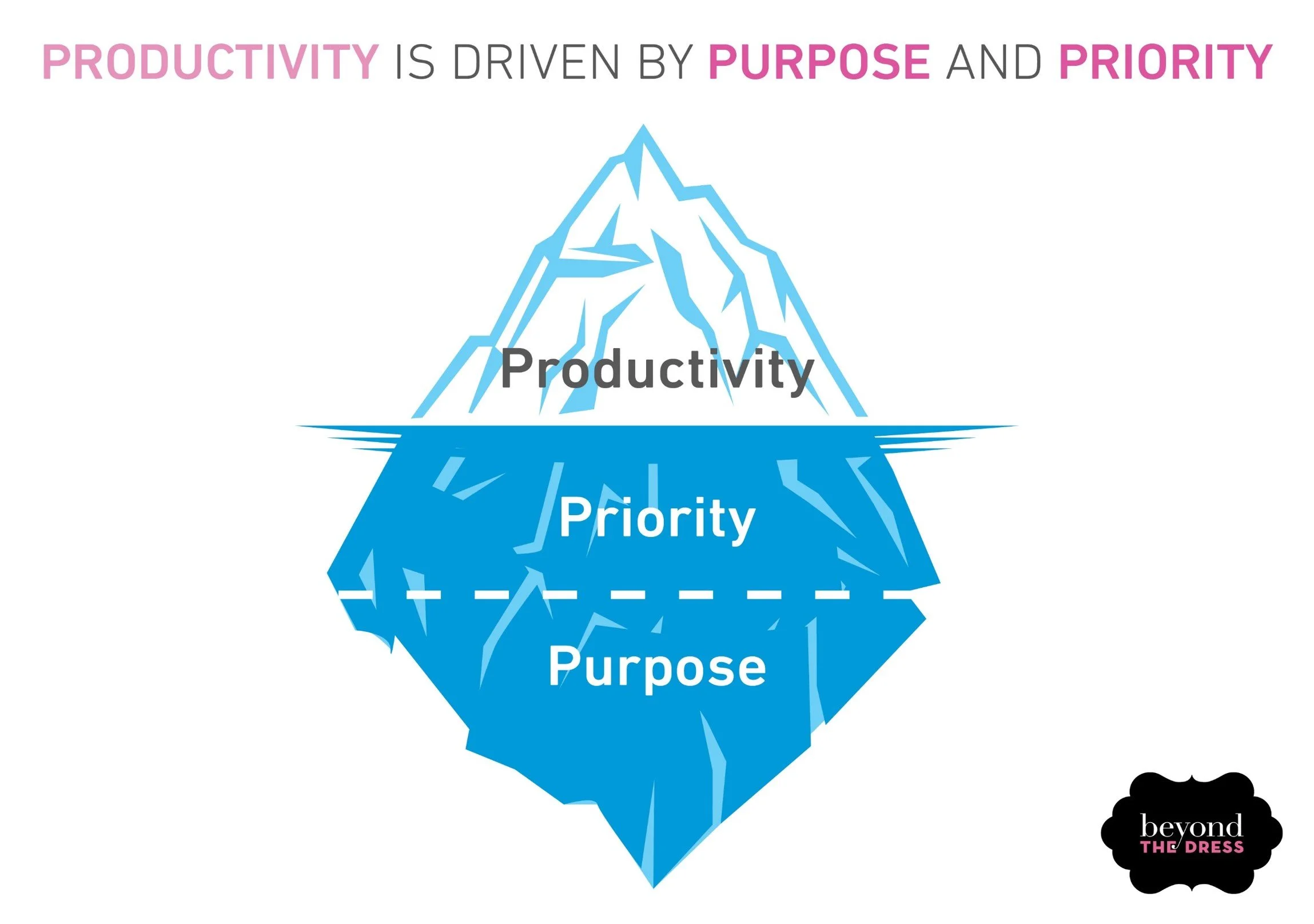
Purpose: Not “why am I on the planet” purpose — the purpose of this task, this meeting, this email. Why does it exist? What is it for? When you know that, your action comes into laser focus.
Priority: What matters most now. Not what matters in theory. Not what matters to everyone else. The most important next step.
And the often-overlooked force that connects them both:
Attention.
Here’s what I see again and again in my work with leaders and teams:
People don’t lack clarity. They don’t even lack priorities.
They lack intentional attention.
We decide what matters… and then wonder why our days don’t reflect it.
Our days aren’t made up of big, dramatic decisions. They’re made up of moments. And what we do with our attention in one moment quietly directs the next chunk of time.
I see this in my own life all the time. When I arrive early to fetch my kids from school, I have a choice. I can open my Kindle and spend those 20 minutes on something that actually feeds me… or I can “just quickly” check my phone and lose myself scrolling.
It’s not that social media is bad. Sometimes it’s useful, funny, even inspiring.
But without intentional attention, it becomes mindless attention — and mindless attention has a way of accumulating into wasted moments.
And that’s the sneaky part: it doesn’t feel like a big deal in the moment… until you add up the week.
Why good intentions still don’t shape our days.
You can be crystal clear on your purpose. You can name your top three priorities without hesitation.
And still end the week feeling scattered, behind, or frustrated.
Why?
Because attention — not intention — is what shapes behaviour.
Or said another way:
What you pay attention to is what your priorities become — whether you mean it or not.
Not on paper. In practice.
Your calendar, your inbox, your energy levels — they’re all telling the truth about where your attention is actually going.
You may genuinely want to stop working long hours… but when your attention keeps going to other people’s priorities, you give away your best time slot. You tell yourself you’ll “fit yours in later.” And later becomes after-hours.
Or you may intend to get fitter… but the moment you wake up, your attention goes to messages, emails, and urgency. Again. Someone else’s “now” becomes your first hour.
We don’t fail because we don’t care.
We drift because attention is subtle. It’s pulled by habit, pressure, and what feels immediately rewarding — like the relief of clearing the inbox, the illusion of control that comes from saying yes, or the dopamine hit of being needed.
Productivity is the outcome, not the starting point.
We often treat productivity as something to fix.
But productivity is a result.
It’s what happens when:
Purpose is clear enough to matter
Priorities are chosen with care
Attention is aligned with both
Without attention, purpose stays abstract. Without attention, priority stays aspirational.
Attention is the bridge between what matters and what gets done.
The uncomfortable (but useful) truth.
We don’t live our priorities. We live our patterns of attention.
And under pressure, those patterns don’t disappear — they default.
To urgency. To habit. To what feels familiar, relieving, or “productive enough” in the moment.
This isn’t a character flaw. It’s human.
Which is why real change rarely starts with a new system. It starts with self-observation.
Not judgment. Not fixing. Just noticing.
If you want a simple practice: at the end of the day, do a tiny “truth audit” with two columns:
What I said I wanted to do
What I actually chose to do
Not to shame yourself — but to see the real forces at play. Awareness gives you something incredibly powerful:
Choice.
A simple exercise to reclaim your attention.
If you’re reading this and thinking, Okay… but what do I do with that? Start here.
Step 1: Name what’s true
What drains my attention – What leaves you scattered, tired, resentful, or foggy?
What holds my attention – What absorbs you — engaging, even if not always meaningful?
What deserves my attention – What moves the needle and aligns with who you’re becoming?
Step 2: Spot the gap (no shame, just clarity)
Circle your top 3 drains and your top 3 deserves. Then answer:
Where is my attention going… and where does it want to go?
Step 3: Micro-reclaim (small is powerful)
Complete these three sentences for the coming week:
I will do less of:
I will protect 15–30 minutes for:
I will say a small no to:
Tip: Your “small no” isn’t about being difficult. It’s about being deliberate. Attention is finite. Protecting it is leadership.
A different question to ask.
Instead of asking:
“How can I be more productive?”
Try asking:
“What has been receiving my attention — and what’s been quietly starved of it?”
That single shift creates coherence.
Not equal time. Not a perfect balance.
But the right attention for this season.
And from there, productivity tends to take care of itself — because you stop trying to force results at the surface… and start working with what’s happening underneath.
Here's to intentional attention,
Warm wishes,
Lori